Choosing between a single-stage and a two-stage air compressor is one of the most critical decisions when setting up a workshop, automotive garage, or industrial manufacturing facility. While both machines compress air to power pneumatic equipment, they differ significantly in mechanical design, maximum pressure (PSI), airflow capacity (CFM), energy efficiency, and total purchase cost.
Selecting the wrong compressor can result in bottlenecked air supply, overheating tools, excessive power bills, and costly premature wear. Conversely, overspending on a high-pressure industrial compressor for simple workshop tasks wastes upfront capital and precious floor space.
This comprehensive buying guide compares single-stage vs. two-stage air compressors across all technical and operational benchmarks to help you make the perfect investment for your business.
What is a Single-Stage Air Compressor?
In a single-stage air compressor, atmospheric air is drawn directly into a cylinder and compressed to its final pressure in one single piston stroke. The compressed air is then delivered directly into the storage tank without passing through an intermediate cooling tube.
Key Characteristics and Advantages of Single-Stage Units:
Single-stage compressors offer unmatched simplicity and reliability for small businesses that do not require 24/7 continuous air demand.
What is a Two-Stage Air Compressor?
In a two-stage air compressor, air is compressed twice in two separate cylinders. First, air is drawn into a larger low-pressure cylinder and compressed to roughly 90 PSI. It then passes through a finned copper or aluminum intercooler tube that cools the air, increasing its density before it enters a smaller high-pressure cylinder where it is compressed up to 175 PSI or more.
Key Characteristics and Advantages of Two-Stage Units:
Two-stage compressors are heavy-duty industrial workhorses engineered to withstand demanding, continuous 24/7 operating schedules.
Head-to-Head Comparison: Single Stage vs Two Stage
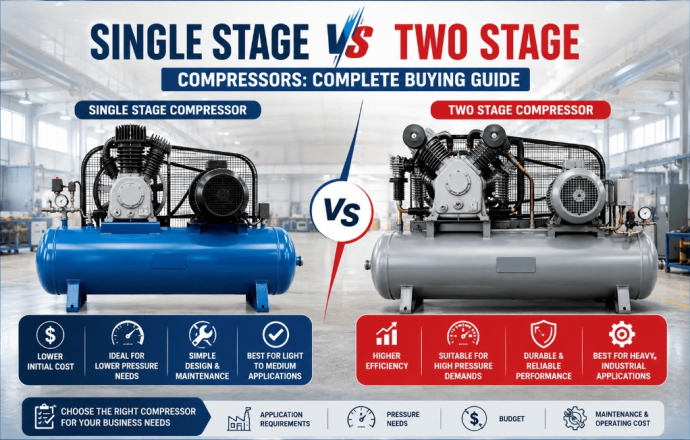
Review this direct performance breakdown to see exactly how both compression systems compare across critical operational metrics:
Single Stage Compressors
Two Stage Compressors
Match your choice to your maximum required PSI and daily operating duty cycle.
How to Choose the Right Compressor for Your Business Needs
Evaluate your purchase decision across these four core criteria to ensure seamless facility operations:
Always add a 25% to 30% safety margin above your current peak CFM consumption to accommodate future tool additions without overloading the pump.
Common Buying Mistakes to Avoid
Avoid these costly purchasing and sizing errors when specifying your new air system:
Sizing your compressor correctly on day one prevents expensive replacements down the road.
Final Thoughts
Whether you should invest in a single-stage or two-stage air compressor comes down to your required air pressure (PSI), total volume demand (CFM), and daily duty cycle. For automotive body shops, small manufacturing cells, and independent contractors operating intermittent pneumatic tools, a single-stage compressor provides reliable, budget-friendly performance.
For heavy industrial assembly lines, large mechanical workshops, and continuous production environments requiring pressures exceeding 150 PSI, a two-stage compressor is the superior choice. Its cooler intercooled operation, superior energy efficiency, and extended mechanical lifespan guarantee maximum productivity and lower long-term operating expenses.
Frequently Asked Questions (FAQs)
Can I run industrial pneumatic tools with a single-stage compressor?
Yes, provided the tools operate under 120 PSI and your total CFM consumption does not exceed the compressor's output rating. However, if multiple heavy tools run simultaneously continuously, a single-stage pump will overheat and struggle to maintain pressure.
Why do two-stage compressors have two cylinders of different sizes?
The first, larger low-pressure cylinder draws in high volumes of atmospheric air and compresses it to around 90 PSI. Because compressed air shrinks in volume when cooled in the intercooler, the second high-pressure cylinder is engineered with a smaller diameter to efficiently compress that denser air up to 175+ PSI.
Does a larger storage tank increase compressor PSI?
No. A larger air tank does not increase the maximum PSI or CFM rating of the pump. Instead, it provides a larger reserve of stored air, allowing tools to operate longer before the motor kicks on, which reduces compressor cycling and saves energy.

Q9 Shop Insights
Premier B2B directory and information hub for industrial machinery manufacturers, suppliers, and enterprise buyers across India.
Explore all articles →